07 May 2026
Modelling UK electricity regional costs for commercial buildings
Presented by Luke
Full citation: Acha, S., Vieira, G., Bird, M. and Shah, N. (2022), Energy and Buildings, 271, 112301
Paper Summary
In this paper, Acha et al. developed the Modelling UK Electricity Regional Costs(MUKERC) framework, a bottom-up methodology that defines all electricity tariff components and aggregates them to quantify the cost per kWh for every half-hour of the day. Developed in response to rising electricity prices, the framework aims to provide non-domestic consumers with the transparency needed to visualise their specific cost components. By improving awareness of spatial-temporal price dynamics, the model supports consumers in developing smart energy management initiatives to tackle increasing operational costs.
Key Results
Figure 1 illustrates the forecasted variation in p/kWh electricity costs across Great Britain for FY 2023–2024. While the absolute price levels may differ from current market realities due to unforeseen wholesale volatility, the framework provides an insight into the significant spatial variation of electricity costs. This regional disparity is driven by regional network charges rather than wholesale energy prices, with the most substantial factor being the Distribution Use of System (DUoS) commodity rate, which varies across the 14 DNO areas according to specific time bands and voltage levels.
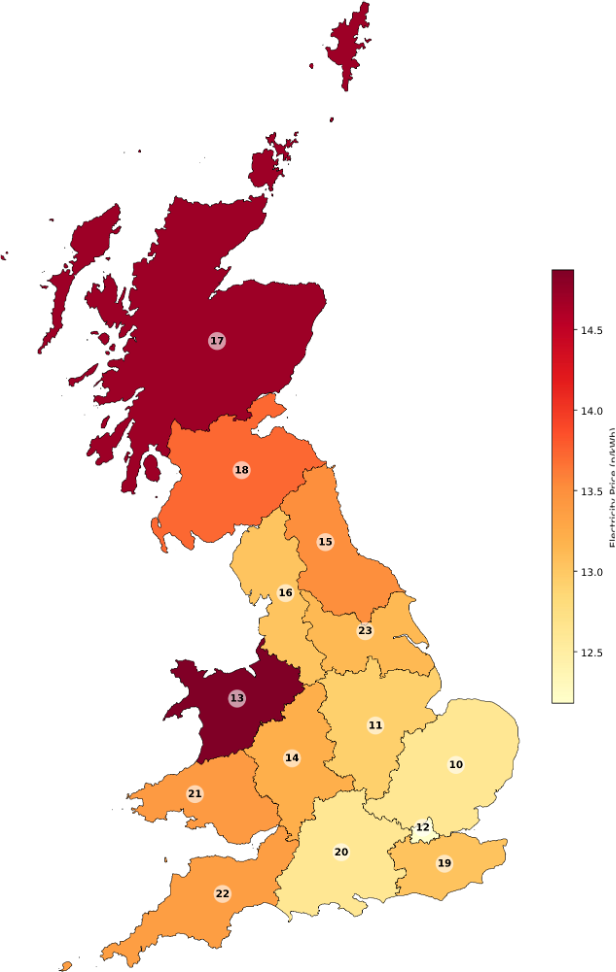
Figure 1: Forecasted variation of regional electricity costs. Adapted from Acha et al. (2022)
Figure 2 illustrates the application of the MUKERC framework to a case study of a university campus in London. The data highlights the shifting relationship between the three primary bill categories: wholesale commodity costs, environmental and social obligations and network costs. Despite being based on 2020 data preceding the Ukraine conflict, the model captures a critical long-term trend in the UK energy sector: the historical dominance of wholesale commodity costs is projected to decline as a proportion of the total electricity bill. This result reinforces the need for clearer understanding of the non-commodity tariff components.
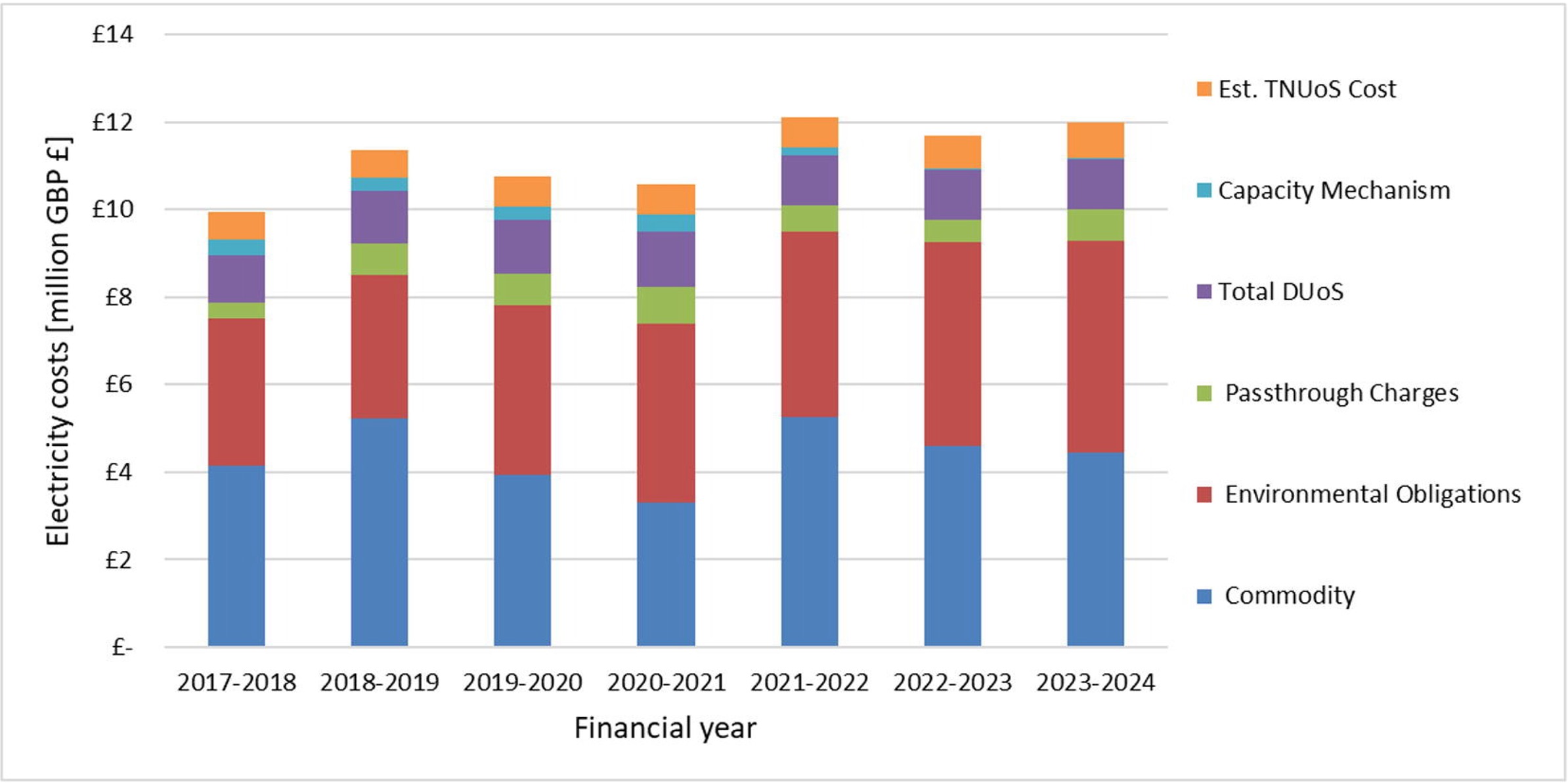
Figure 2: Total annual electricity costs and tariff component breakdown for a London university campus. Source: Acha et al. (2022)
Discussion Questions
- What measures can businesses employ to mitigate the impact of rising electricity costs?
- What policy decisions should the government take to protect UK consumers from rising electricity costs?
Attachments
Suggestions for further reading
- Industry report on the impact of high non-domestic electricity costs: Cutting Business Energy Costs: The case for action - https://www.energy-uk.org.uk/publications/cutting-business-energy-costs-the-case-for-action/
- Academic paper on the impact of electricity tariff switching: Power-use profile analysis of non-domestic consumers for electricity tariff switching - https://doi.org/10.1007/s12053-015-9404-9