11 Jun 2026
Stochastic simulation-optimization framework for the design and assessment of renewable energy systems under uncertainty
Presented by Tanya
Full citation: G.K. Sakki, I. Tsoukalas, P. Kossieris, C. Makropoulos, A. Efstratiadis. Renewable and Sustainable Energy Reviews, 168, 112886.
This paper proposes a generic stochastic simulation-optimisation framework tailored to renewable energy systems (RES), which addresses external and internal facets of uncertainty. The proposed framework is applied to two indicative case studies (hydro and wind), with a methodological triptych (statistics, stochastics and copulas). Both cases reveal that the ignorance/underestimation of uncertainty may hide a significant perception about the actual operation and performance of RES.
Background
The systematically increasing penetration of RE introduces further complexities to the global energy scene, due to multiple and interacting uncertainties. Sources of uncertainty can be addressed across project design and economic assessment, and can be defined as:
- Internal: arising from efficiency curves of equipment, model assumptions and equipment degradation
- External: refers to hydrometeorological processes, highly-complex and unpredictable socioeconomic and environmental factors, as well as conflicts within the broader energy-society nexus, e.g., land development
Both have separately been widely researched, but their combined effects (and the interplay of their dependencies) have received considerably less attention - leading to a fragmented approach in planning and management for RES. Ignoring uncertainty results in fully deterministic outcomes, which eventually leads to risky decisions.
The research
In this paper, two separate cases are studied - a small hydro, run-of-river plant, and a wind power park. The problems involve a design optimisation for the hydro plant (optimal turbine mixing) and a long-term economic assessment for the wind park. The methodological triptych is modelled under three uncertainty settings: Setting A (Statistical only; marginal distributions), Setting B (Stochastic; Setting A + seasonality and cross-scale dependencies), Setting C (Full; Setting B + internal efficiency uncertainty via parametric sampling)
Results and insights
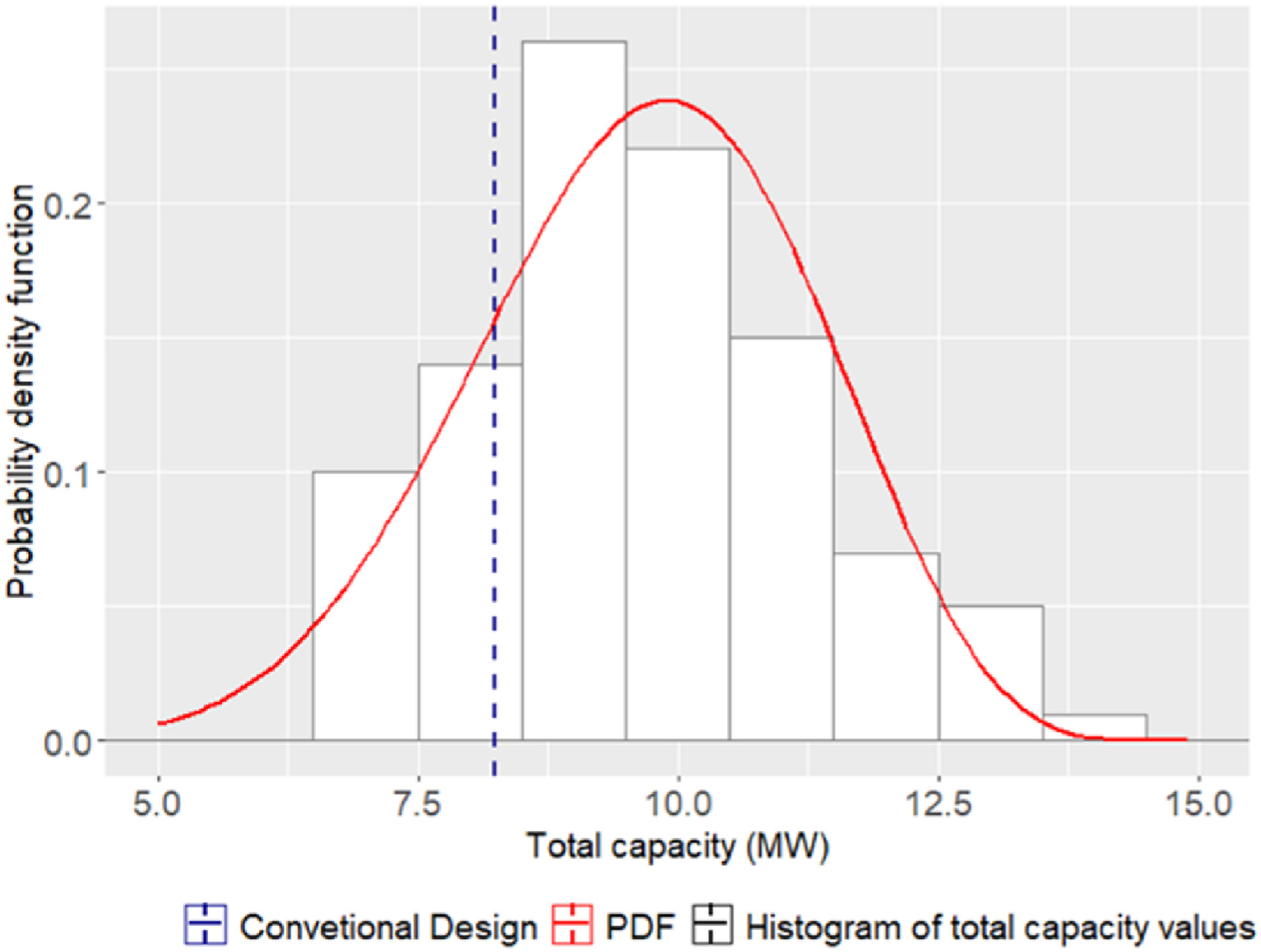
For the hydro plant, the deterministic simulation results in a single capacity value of 9.9 MW, while Setting C gives a capacity range of 6.7-13.7 MW. While for the wind park, the deterministic simulation results in a single income estimate (EUR 0.36M/yr), which falls below the stochastic range (EUR 0.37M - 0.66M/yr). Setting B reveals substantially more uncertainty than Setting A; in the hydro design, Setting C flipped the optimal turbine hierarchy.
Discussion Question
- What are the shortfalls of the uncertainty handling technique used in this paper?
Attachments
Further reading
- Yue, X., Pye, S., DeCarolis, J., Li, F.G.N., Rogan, F. and Ó Gallachóir, B. (2018) ’A review of approaches to uncertainty assessment in energy system optimization models’, Energy Strategy Reviews, 21, pp. 204–217. doi: 10.1016/j.esr.2018.06.003.