21 May 2026
The Sustainability Dimension for Sustainable Aviation Fuels
Presented by Emily
Full citation: Prussi, M. The Sustainability Dimension for Sustainable Aviation Fuels (SAF): Comparing Regional and International Approaches. Sustainability 2025, 17, 8401.
Summary of Paper
This paper examines how different regulatory systems define and certify Sustainable Aviation Fuel (SAF), comparing the European Union framework (RED III + ReFuelEU Aviation) and the international ICAO (CORSIA) framework.
SAF is considered the most promising near-term decarbonisation solution for the aviation sector; however, the paper argues its deployment is not only constrained by fuel technology itself, but also by fragmented sustainability certification systems and regulatory requirements. The paper highlights discrepancies among several factors, including greenhouse gas thresholds, feedstock restrictions, life-cycle assessment methods, and traceability requirements, creating major challenges for international operations. The paper suggests that these differences increase compliance costs, administrative burden, certification duplication and market fragmentation.
Key Results
Chain of Custody (CoC) & Traceability
- Identity Preservation (IP)
Ensure certified fuel remains fully separated and traceable throughout the entire supply chain. - Segregation (SG)
Certified fuels can be mixed only with other certified fuels that meet the same sustainability standard - Mass Balance (MB) – most common
SAF and fossil fuels can be physically mixed, while sustainability attributes are tracked through an accounting system - Book & Claim System
SAF sustainability credits can be traded separately from the physical fuel, allowing airlines to claim SAF usage without directly receiving SAF
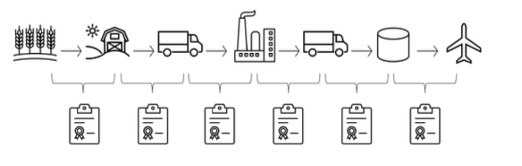
Overview of chain of custody and related documental traceability
Sustainability-Certification Frameworks
The paper concludes that although both frameworks aim to promote SAFs, they differ significantly in sustainability requirements, greenhouse gas thresholds and traceability systems. The EU adopts a stricter regulatory approach, requiring at least a 70% GHG reduction relative to the fossil baseline comparator of 94 gCO₂eq/MJ, while CORSIA currently applies a lower 10% threshold. RED III excludes many food and feed-based biofuels and applies strict restrictions to high indirect land-use change (ILUC) risk feedstocks, whereas CORSIA adopts a more flexible feedstock approach while incorporating quantified ILUC factors into its life-cycle assessment methodology.
| Aspect | EU (RED III/ReFuelEU Aviation) | CORSIA (ICAO) |
|---|---|---|
| Environmental Criteria | Strict no-go land rules, ILUC risk feedstock caps, mandatory LCA | Principle-based, ILUC defaults, broader feedstock flexibility |
| Social Criteria | Defined via voluntary schemes | Mandatory themes (e.g., labor rights, food security |
| Certification Body | EU-recognized Voluntary Schemes | ICAO-approved SCS (i.e., ISCC, RSB and ClassNK) |
| Verification Model | Annual audits, traceability, EU registry (UDB) | Traceability templates, CORSIA registry, MRV |
| Chain of Custody | Mass Balance, segregation, supply chain documentation | Mass Balance or segregation, supply chain documentation |
| Scope of Certification | Fuel type + feedstock + land origin | Fuel + process + compliance with sustainability themes |
Table 2. Comparison of sustainability certification requirements: EU vs CORSIA
Discussion Questions
- Is CORSIA’s lower threshold a pragmatic entry point for a global scheme, or does it increase the risk of greenwashing at scale? Should SAF sustainability standards be globally harmonised, or should regions maintain their own stricter frameworks?
- Do systems like Mass Balance and Book & Claim provide sufficient transparency, or are they too dependent on administrative accounting? Should SAF sustainability be verified by physical measurements and emissions monitoring?
Attachments
Recommended Readings
- Heyne, J., Rauch, B., Le Clercq, P. and Colket, M., 2021. Sustainable aviation fuel prescreening tools and procedures. Fuel, 290, p.120004. https://doi.org/10.1016/j.fuel.2020.120004
- Rauber, M., Salazar, G., Yttri, K.E. and Szidat, S., 2023. An optimised organic carbon / elemental carbon (OC /EC) fraction separation method for radiocarbon source apportionment applied to low-loaded Arctic aerosol filters. Atmospheric Measurement Techniques, 16, pp.825–844. https://doi.org/10.5194/amt-16-825-2023